
Which record do you want to check?
The most-streamed song on a day and the recording with the largest accumulated total answer different questions. A chart position is not itself a stream count. Define measure, period, territory and source before looking for a name.
There is no live counter or current winner assigned from an old list on this page. The original publication date remains. A fresh comparison requires a dated source and a record of its conditions.
One number is not enough
Keep its link, artist, release and version.
Streams, chart position and personal minutes differ.
Retain the period, territory and source.
Identify the recording
A song may have studio, live, remastered and remixed versions. Similar titles do not prove a shared identifier. Keep the particular track and release links, plus the rule by which you intend to combine or separate versions.
Spotify defines a release total through its tracks. Its documentation also explains that a song appearing on several releases contributes to the relevant release totals. Adding those totals without checking can count activity more than once.
What Spotify calls a stream
Current Spotify for Artists help specifies at least 30 seconds of playback for a song stream. That does not make every personal JSON row passing that threshold identical to the final official count. Source, context and the purpose of the data still matter.
Personal minutes are a sum of supplied durations. A public counter and a chart concern different datasets. These units cannot replace one another or supply a universal royalty calculation.
Fill in a comparison card
| Field | What to record |
|---|---|
| Entity | Artist, title and specific URL or identifier |
| Version | Studio, live, remix or another stated edition |
| Measure | Stream count or position in a named chart |
| Coverage | Day, week or cumulative period with exact boundaries |
| Territory | Selected country or global, as the source defines it |
| Origin | URL, observation date and time, retained snapshot |
If a source supplies only position, leave the stream-count field blank. If coverage is unknown, do not fill it with a guess. A missing value is not zero.
A reproducible example
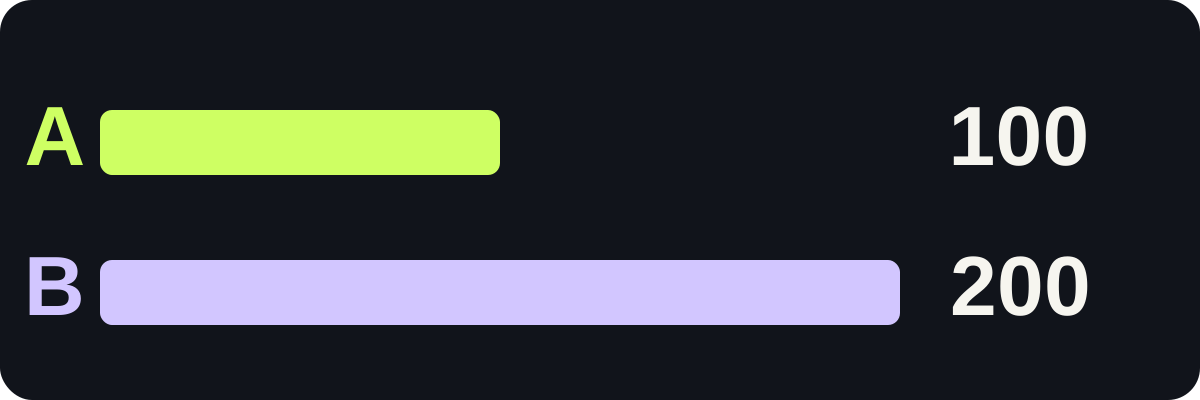
Imagine recordings A and B with 100 and 200 events in the same example period. B has twice as many events in that comparison. This says nothing by itself about monthly audience, listening minutes, revenue or an all-time record.
If A and B are versions of one song, first decide whether the versions are being studied separately. A combined total needs compatible sources and a clear rule. Retain the underlying rows so another reader can reproduce it.
Before naming a leader
- Open the chosen official chart edition or another primary source.
- Verify date, territory and unit.
- Check the specific recording, not only its title.
- Preserve the source and put the observation date beside the claim.
- Do not turn a daily result into an all-time claim.
A useful headline names precisely the measure it establishes. For your own most-played song, use a personal view or history export: that describes your listening, not a worldwide record.
Sources and useful next steps
Source documentation checked 17 October 2026. Calculations and worksheets are explanatory examples, not reported artist results.