
Decide what “most” means
The leader by cumulative plays, the leader in today's chart and the artist with the largest monthly audience can be different people. Start with the measure rather than a name. Without a period and a source, “the biggest artist on Spotify” is not a reproducible answer.
This page explains how to build a comparison; it is not a live leaderboard. The original publication date is retained. A current winner must be checked in the selected source on a stated date, rather than carried forward from an earlier list.
Three scales of popularity
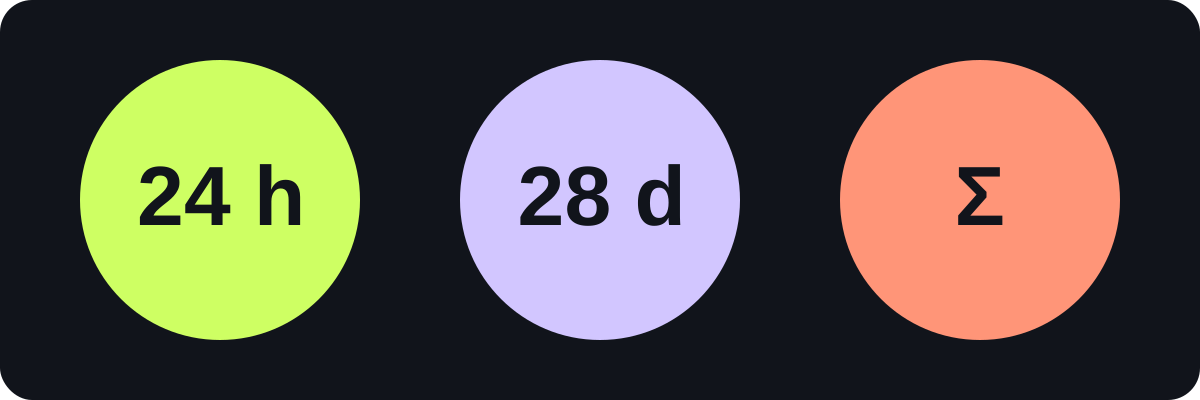
Record the day, territory and chart measure.
Unique listeners are not a stream count.
Keep the source, catalog coverage and observation date.
Make an observation card
- Choose the question: current chart activity, audience reach or accumulated catalog activity.
- Name the measure and the entity: artist, track or release.
- Fix the territory, period and observation date.
- Keep the exact chart or profile link and a source snapshot.
- Compare rows only when their definitions match.
Official Spotify Charts is a starting point for a dated chart question. A public monthly-listener figure describes another measure. If a source does not supply a cumulative total for the full catalog, leave that field blank rather than combining incompatible third-party estimates.
A worksheet someone else can check
| Entity | Measure | Territory | Period | Value | Source and date |
|---|---|---|---|---|---|
| Artist A | Unique listeners | As the source defines it | Rolling 28 days | Read from profile | Preserve link and snapshot |
| Track B | Chart position | Selected country or global | Exact day | Read from chart | Preserve chart edition |
| Catalog C | Cumulative events | As defined by source | Up to observation date | Only if supplied | Record catalog coverage |
This is a blank working template: A, B and C are not actual leaders. It makes you record context before placing numbers on the same graphic.
Why the answer can change
A new release, a catalog addition, another territory or a different date can change the comparison. Re-recordings, remixes and featured appearances also need a clear inclusion rule. A track and a release are not interchangeable rows.
Imagine A has more accumulated events while B has more unique listeners in the latest window. There is no contradiction. One describes summed activity; the other describes a recent audience. Switching the unit cannot establish B as the all-time leader.
Keep financial claims separate
Streams do not establish a universal payment per play, profit or contract terms. Audience is not a ticket-buyer count. Those conclusions need different evidence. A missing value means unknown, not zero performance.
If you meant your own favourite artists
A public leader need not lead your listening. Use personal Listening stats or your audio-history export. Keep the period and measure—minutes or records—with the result. Your files cannot reveal a worldwide audience.
Before publishing a conclusion
Check each name, date, unit, territory and source. Mark missing observations and rounding. Make the headline describe the chosen measure, rather than a broader claim of supremacy. Repeat the procedure on a new date as a new row, preserving the earlier observation.
Sources and useful next steps
Source documentation checked 17 October 2026. Calculations and worksheets are explanatory examples, not reported artist results.