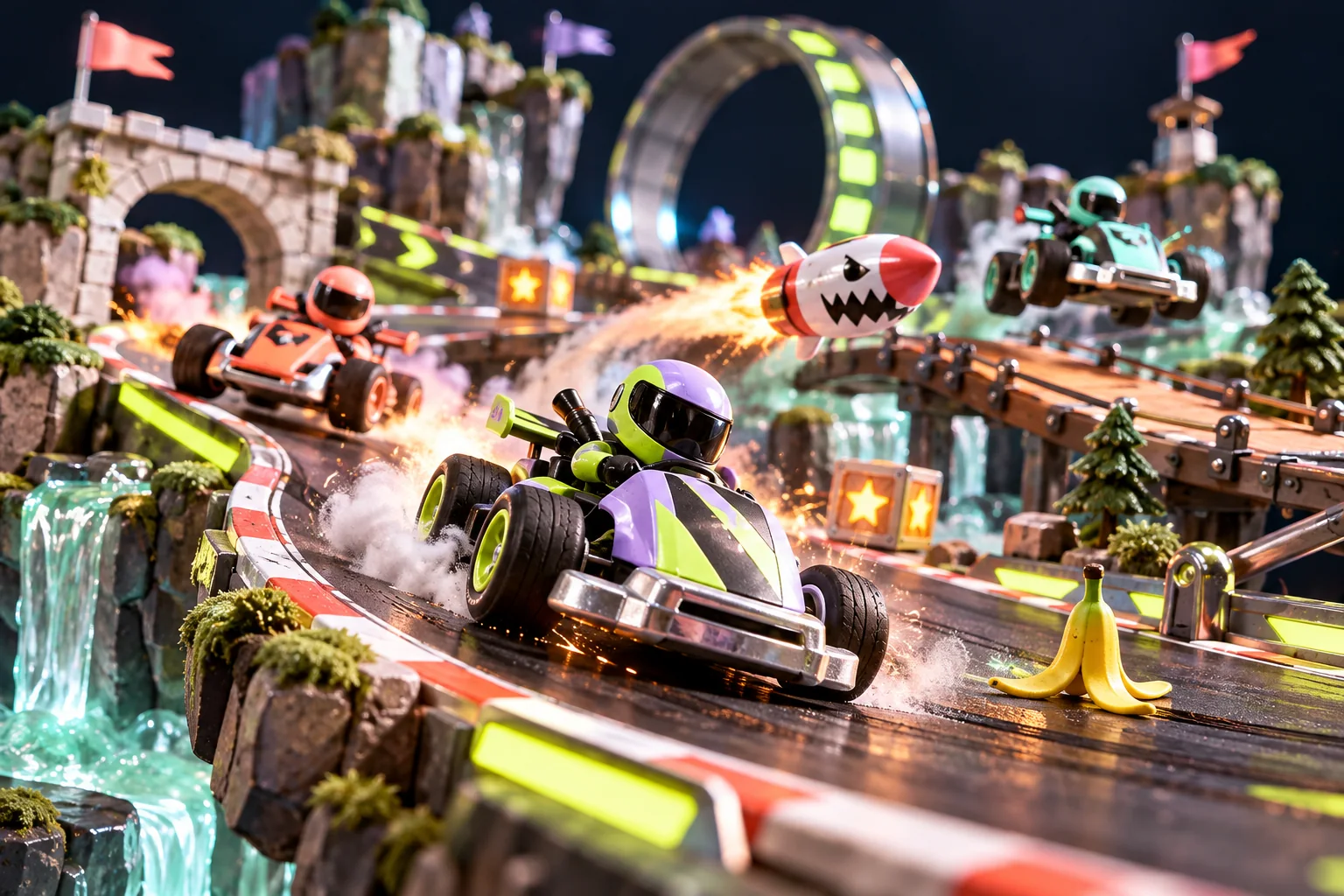
Your route through this guide
What Makes Smash Kart Racing Uniquely Addictive
This kart racing battle game achieves its popularity through several key elements:
Perfect Accessibility Balance: Easy to learn controls with surprising depth
Chaotic Unpredictability: Game-changing events that prevent races from feeling predetermined
Satisfying Comeback Mechanisms: Power-ups that allow trailing players to remain competitive
Social Competition Appeal: Multiplayer focus that creates memorable shared experiences
Quick Session Design: Complete races that fit perfectly into short break periods
These foundational strengths create an experience that captures the essence of console kart racing classics while remaining completely playable in a browser environment.
Essential Driving Fundamentals
Success begins with developing these core racing skills:
Drift Boosting: Mastering the timing of power slides for speed advantages
Starting Line Acceleration: Perfecting the race start for early positioning
Corner Approach Optimization: Taking ideal racing lines through turns
Shortcut Discovery: Finding and utilizing hidden path advantages
Draft Utilization: Gaining speed boosts by driving behind opponents
Players who develop these fundamental techniques will find themselves consistently placing higher in races, creating more opportunities for victory even without power-up advantages.
Advanced Racing Strategies
For those seeking racing mastery, these sophisticated approaches are essential:
Defensive Driving Routes: Positioning to minimize exposure to attacks
Speed vs. Item Balance: Strategic decisions between optimal racing lines and power-up collection
Minimap Awareness: Monitoring opponent positions for tactical decisions
Terrain Adaptation: Adjusting driving style for different track surfaces
Recovery Optimization: Minimizing time lost after being hit by items
These advanced techniques separate casual players from serious competitors, enabling consistent success even in chaotic multiplayer environments.
Strategic Item Utilization
Effective power-up usage often determines race outcomes:
Timing Optimization: Using items at moments of maximum impact
Target Selection: Choosing the most threatening opponents to attack
Item Preservation: Holding defensive tools when in vulnerable positions
Chain Reaction Planning: Creating cascading effects with well-placed weapons
Counter-Item Strategy: Using specific power-ups to neutralize incoming attacks
These item strategies transform random power-up collection into deliberate tactical advantage, adding significant strategic depth to the racing experience.
Weapon-Specific Tactics
Each power-up requires unique approaches for maximum effectiveness:
Projectile Trajectory Mastery: Accurately landing shots on moving targets
Explosive Placement Precision: Positioning area-effect items in high-traffic areas
Speed Boost Sequencing: Chaining acceleration items for maximum advantage
Shield Timing Optimization: Activating protective items just before attacks
Special Weapon Techniques: Utilizing unique properties of rare power-ups
These weapon-specific skills create a meta-game beyond pure racing, where understanding each item's potential becomes as important as driving ability itself.
Map-Specific Racing Strategies
Different tracks demand unique approaches:
Terrain Type Adaptation: Adjusting driving for various surface conditions
Hazard Navigation Techniques: Avoiding or minimizing track-specific dangers
Elevation Change Handling: Mastering uphill climbs and downhill acceleration
Optimal Path Identification: Finding the fastest routes through complex layouts
Environmental Interaction: Using track elements for advantage
This track-specific knowledge rewards experience and observation, creating satisfying depth as players learn the nuances of each racing environment.
Shortcut Discovery and Utilization
Finding alternative routes provides crucial advantages:
Hidden Path Location: Identifying concealed alternatives to main routes
Risk/Reward Assessment: Evaluating shortcut danger versus time saved
Entry Point Precision: Mastering the exact positioning for alternative paths
Speed Maintenance Techniques: Preserving momentum through irregular routes
Vehicle Suitability Matching: Knowing which karts best handle specific shortcuts
These shortcut strategies create significant advantages for knowledgeable players while adding exploration incentives beyond pure competition.
Racer Stat Optimization
Character and vehicle choices significantly impact performance:
Speed vs. Handling Balance: Choosing appropriate stats for different tracks
Acceleration Prioritization: Selecting faster-starting options for certain courses
Weight Class Advantages: Understanding the benefits of heavier or lighter karts
Special Ability Utilization: Leveraging character-specific skills effectively
Personal Playstyle Matching: Selecting options that complement your racing approach
These selection strategies add pre-race depth to the competition, creating important decisions before engines even start.
Matchup Considerations
Choices should consider both track and competition:
Course-Specific Counter Selection: Choosing characters strong on particular tracks
Opponent Prediction Adaptation: Selecting to counter expected competition choices
Team Composition Coordination: Creating complementary groups in team modes
Meta-Trend Response: Adapting to popular character selections
Surprise Factor Utilization: Using unexpected choices to create uncertainty
These matchup considerations add a strategic layer similar to character selection in fighting games, where choices exist within a complex ecosystem of strengths and weaknesses.
Race Position Strategies
Different leaderboard positions require unique approaches:
Frontrunner Defense: Maintaining first place against item disadvantages
Pack Positioning: Finding optimal mid-race positions to avoid major conflicts
Comeback Execution: Maximizing recovery from early mistakes or attacks
Final Lap Timing: Making decisive moves at optimal moments
Place-Specific Item Strategy: Adapting power-up usage based on current position
These positional strategies create dynamic races where optimal approaches change constantly based on leaderboard standing.
Psychological Warfare Techniques
Mental game often proves as important as racing skill:
Intimidation Driving: Demonstrating skill to affect opponent confidence
Unpredictability Cultivation: Creating uncertainty about your next actions
Revenge Prevention: Avoiding becoming targeted after aggressive plays
Risk Perception Manipulation: Making opponents believe certain routes are better/worse
Pressure Application: Creating situations where opponents make mistakes
These psychological elements transform Smash Kart from pure racing into a complex competitive experience where mental resilience matters alongside technical skill.
Cooperative Racing Techniques
Team modes require collaborative approaches:
Drafting Chains: Creating speed boost sequences for teammates
Item Sharing Coordination: Passing power-ups to those in optimal positions
Path Clearing Roles: Removing obstacles for following teammates
Position Trading Strategy: Alternating lead to share defensive responsibilities
Interference Coordination: Blocking opponents while teammates advance
These teamwork elements add social depth to the racing experience, creating opportunities for coordinated strategy beyond individual skill.
Communication and Role Division
Effective teams establish clear structures:
Callout Systems: Concise methods for sharing crucial information
Specialized Position Assignment: Designating offensive and defensive roles
Item Type Allocation: Determining who uses which power-ups
Target Priority Coordination: Focusing attacks on specific opponents
Adaptive Leadership Rotation: Changing shotcaller based on race position
These communication strategies transform casual team play into coordinated competition, similar to more complex esports while remaining accessible to casual players.
Quick Fun Session Approaches
For casual enjoyment during breaks:
Chaotic Item Emphasis: Embracing the unpredictable fun of power-up madness
Track Variety Prioritization: Experiencing different environments over mastery
Character Experimentation: Trying various options rather than optimizing choices
Social Focus: Prioritizing memorable moments over competitive outcomes
Low-Pressure Participation: Enjoying the experience regardless of placement
These casual approaches maximize fun during quick gaming sessions, perfect for short break periods or social play.
Serious Competition Techniques
For those seeking competitive mastery:
Consistent Practice Regimens: Dedicated improvement of specific skills
Meta Analysis Understanding: Staying current with optimal character/track strategies
Tech Skill Development: Mastering advanced movement and item techniques
VOD Review Implementation: Studying recorded races for improvement opportunities
Tournament Participation: Engaging in organized competitions
These competitive approaches transform casual kart racing into a serious esport experience, providing long-term engagement through skill development and measurable improvement.
Network Limitation Adaptations
For reliable play in controlled internet settings:
Bandwidth Usage Minimization: Efficient data transmission for limited connections
Server Selection Optimization: Choosing game hosts with best available access
Packet Loss Compensation: Maintaining playability despite connection issues
Offline Practice Utilization: Developing skills without continuous connectivity
Alternative Access Methods: Multiple paths to game servers for restricted networks
These connection adaptations ensure smooth gameplay even in environments with significant internet limitations, maintaining competitive integrity despite restricted access.
Educational Setting Considerations
For appropriate play in school environments:
Volume Management: Controlling game audio for shared spaces
Time Boundary Respect: Selecting appropriate race counts for available breaks
Appropriate Competition Intensity: Maintaining positive social atmosphere
Technical Resource Consideration: Balancing game needs with shared computer resources
Educational Connection Possibility: Linking racing concepts to physics and mathematics
These considerations make Smash Kart particularly suitable for educational settings where appropriateness and resource management remain important alongside entertainment value.